
Table of Contents
You’ve probably pasted a piece of text into an AI checker and gotten a percentage back, whether you were grading an essay, editing a freelancer’s draft, or double-checking your own writing. What most tools won’t tell you is how that number is calculated, how often it’s wrong, and what to do when it is. In this guide, we’ll explain how ChatGPT detectors work, compare the leading tools, and show you how to interpret results with confidence.
Key Takeaways
- A ChatGPT detector is a tool that estimates the likelihood that a piece of text was generated by an AI model rather than written by a human.
- Detectors analyze predictability (perplexity) and variation in sentence length and structure (burstiness) to produce a probability score.
- No ChatGPT detector is 100% accurate, and all can produce false positives (human text flagged as AI) and false negatives (AI text missed).
- Non-native English writing and highly formal or formulaic text are more likely to be wrongly flagged as AI-generated.
- Paraphrasing, heavy editing, and “humanizer” tools can lower detection scores, which makes a single result unreliable.
- Running the same text through two or three detectors and reviewing draft history gives a far more reliable judgment than one score.
- Writers can reduce false flags by adding specific personal details, varying sentence structure, and keeping version history as proof of process.
What Is a ChatGPT Detector?
A ChatGPT detector is a software tool that analyzes text for statistical patterns and estimates the probability that it was generated by an AI language model such as ChatGPT. Most detectors return a percentage score, and many also highlight the sentences they find most “AI-like.”
Moreover, these tools don’t read for meaning the way a person does. They measure how the text is built. For example, a detector might report “87% likely AI-generated” for a polished, evenly paced essay, even if a student wrote every word.
Detectors are often grouped with plagiarism software, but they work differently. A plagiarism checker matches your text against existing sources, while a detector judges the writing style itself. If you’re comparing both types, see our guide to plagiarism checker tools . You can also learn how best AI writing assistants differ in the text they produce.

Why Do ChatGPT Detectors Matter?
ChatGPT detectors matter because they help schools, publishers, and employers verify authorship at a time when AI can produce fluent text in seconds. Their results can also affect real people, which makes understanding them essential.
First, education depends on them. Teachers use detectors to protect fairness in grading, and many institutions are updating their academic integrity policies.
Second, publishing and SEO teams use detectors to enforce quality standards. For example, an editor might screen freelance submissions before paying for them. Google’s guidance focuses on content quality rather than how it was produced, so see our breakdown of AI-generated content and SEO .
Finally, the stakes cut both ways. A wrong score can damage a student’s record or a writer’s reputation, which is why accuracy matters so much.
How Do ChatGPT Detectors Work?
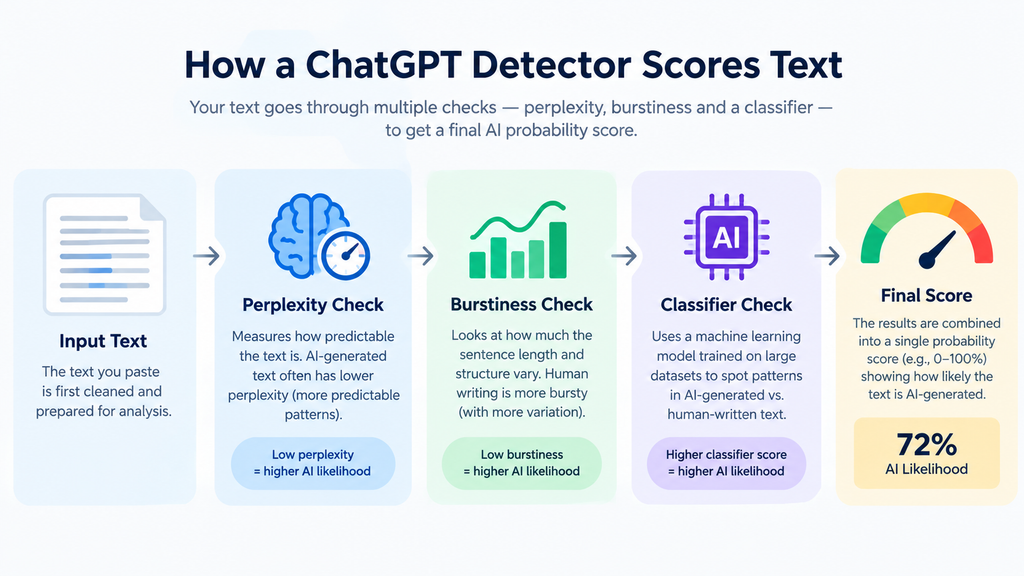
ChatGPT detectors work by comparing a text’s statistical patterns against patterns learned from large sets of human and AI writing. Most rely on a mix of three signals.
What Are Perplexity and Burstiness in AI Detection?
Perplexity is a measure of how predictable a text’s word choices are to a language model. Burstiness is a measure of how much sentence length and structure vary across a passage.
Plus, AI text tends to score low on both. For example, a paragraph where every sentence runs 18-22 words and uses expected phrasing looks “smooth” to a detector. Human writing usually mixes long sentences with short ones. To understand why models write this way, read how AI writing tools work .
How Do Classifier Models and Watermarks Fit In?
A classifier is a model trained on labeled examples of human and AI text to predict which category new text belongs to. A watermark is a hidden statistical pattern embedded in AI output by the model’s developer, which a matching detector can later recognize.
In addition, watermarking only works when the AI provider adds it and the text hasn’t been heavily rewritten. As such, most public detectors still depend on classifiers.
Are ChatGPT Detectors Accurate?
ChatGPT detectors are not fully accurate, and no tool can prove who wrote a piece of text. Their scores are probability estimates that can be wrong in both directions.
The research is sobering. A 2023 study of 14 detection tools found that none reached 80% accuracy, and only five scored above 70% — Source: [Weber-Wulff et al., International Journal for Educational Integrity, 2023]. Even OpenAI’s own classifier correctly flagged only 26% of AI-written text while mislabeling 9% of human text as AI — Source: [OpenAI, 2023]. OpenAI discontinued its own AI text classifier in July 2023, citing its low rate of accuracy.
Bias is another problem. Detectors wrongly flagged more than half of essays by non-native English speakers as AI-generated, with an average false positive rate of 61.3% — Source: [Liang et al., Stanford University, Patterns, 2023]. In other words, writers with simpler, more predictable English are penalized for their style.
Scale matters too. Turnitin reported a document-level false positive rate below 1% — Source: [Turnitin, 2023]. However, Vanderbilt University disabled the feature, noting that even 1% would mean roughly 750 wrongly flagged papers out of 75,000 — Source: [Vanderbilt University, 2023]. For more on why prompts shape output, see our guide to writing effective ChatGPT prompts .
Can ChatGPT Detectors Detect Paraphrased or Edited AI Text?
ChatGPT detectors struggle to detect paraphrased or heavily edited AI text because editing restores the variation detectors look for. For example, running an AI draft through a “humanizer” or rewriting every third sentence can drop a score from 90% to under 30%. This is why one score should never be treated as proof.

What Is the Best Free ChatGPT Detector?
The best free ChatGPT detector depends on your goal, but GPTZero, ZeroGPT, and Copyleaks all offer limited free checks, while Originality.ai and Winston AI are paid tools built for publishers. No single option wins on every test.
Let’s take a look at how common options compare. Fill in your own test results before publishing.
| Tool | Free Tier | Best For | Main Limitation |
|---|---|---|---|
| GPTZero | Yes (limited) | Educators, sentence-level highlights | Can flag formal writing |
| ZeroGPT | Yes | Quick, no-signup checks | Inconsistent on edited text |
| Copyleaks | Limited trial | Teams, multilingual text | Paid for full features |
| Originality.ai | No | Publishers, SEO agencies | Paid; strict scoring |
| Winston AI | Limited trial | Scanned docs, reports | Paid for full access |
| Turnitin | Via institutions | Schools and universities | Not sold to individuals |
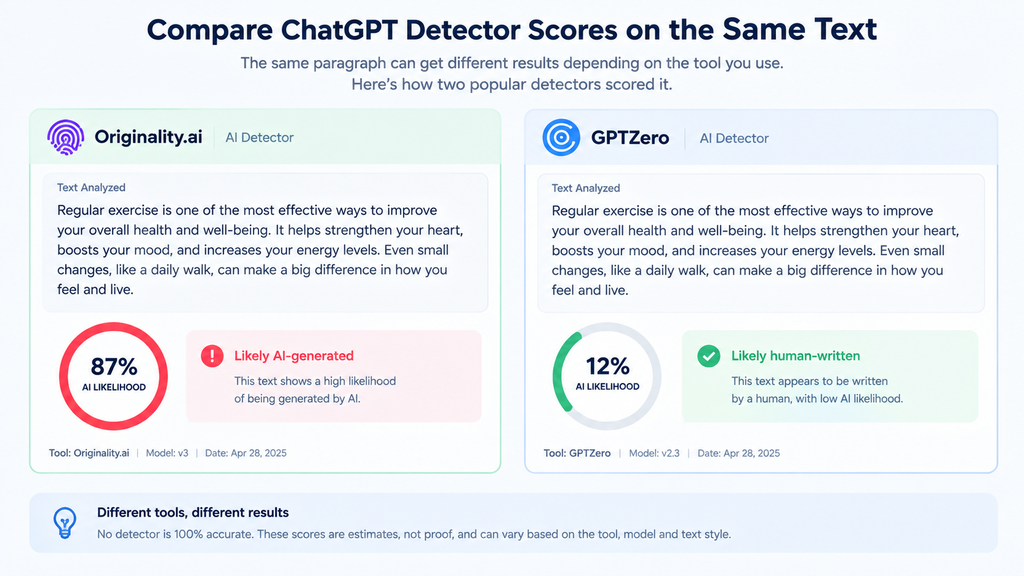
Original test results (writer to insert): Run four identical samples through each tool: pure AI text, pure human text, edited AI text, and non-native human writing. Then publish the scores. This original data is what will set your article apart.
How Do You Check If Something Was Written by ChatGPT?
You check if something was written by ChatGPT by running it through two or three detectors and then reviewing the writing’s context. Here’s the process:
- Paste at least 300 words. Short samples produce unreliable scores.
- Run a second and third detector. If scores disagree widely, treat the result as inconclusive.
- Read the highlighted sentences. Look for generic phrasing, repeated structures, and missing specifics.
- Check version history. Google Docs or Word revision history shows whether text appeared gradually or all at once.
- Talk to the author. Ask them to explain their sources and reasoning.
For a repeatable review process, use a content quality checklist (Internal link: “content quality checklist” → your editorial QA checklist).
What Should You Do If You’re Falsely Accused of Using AI?
If you’re falsely accused of using AI, the best response is to calmly provide evidence of your writing process. Detector scores alone are not proof, and you can say so politely.
For example, share your draft history, outline, research notes, and timestamps. Offer to discuss your argument or rewrite a paragraph live. By staying factual and cooperative, you can shift the conversation from a score to your actual work.
How Can You Make Writing More Human and Original?
You can make writing more human by adding specific, personal, and varied content that a language model would not generate on its own. This also improves quality, regardless of any detector.
- Add real examples. For instance, mention a project you ran or a number you measured.
- Vary your rhythm. Mix short sentences with longer ones.
- Cut filler phrases. Generic openers and stock transitions are common AI signals.
- Edit AI drafts honestly. If you use AI, follow our guide on how to humanize AI-generated text , and follow any disclosure rules.
What’s Next After Running a ChatGPT Detector?
After running a detector, your next step is to combine the score with human judgment and a clear policy. A score is a starting point for review.
First, test important text with two or three tools. Second, keep draft history for anything you write. Third, set a written AI-use policy for your class or team using an AI content policy template. Finally, strengthen your content with E-E-A-T content best practices and a solid SEO content brief template .

Conclusion
A ChatGPT detector is a useful signal, but it is never a verdict. The tools measure patterns, make mistakes, and can be fooled or can wrongly accuse honest writers. You’ll get the best results by comparing multiple detectors, reviewing the writing process, and relying on transparent policies. Use detectors to start a fair conversation, and let your judgment and your evidence finish it.